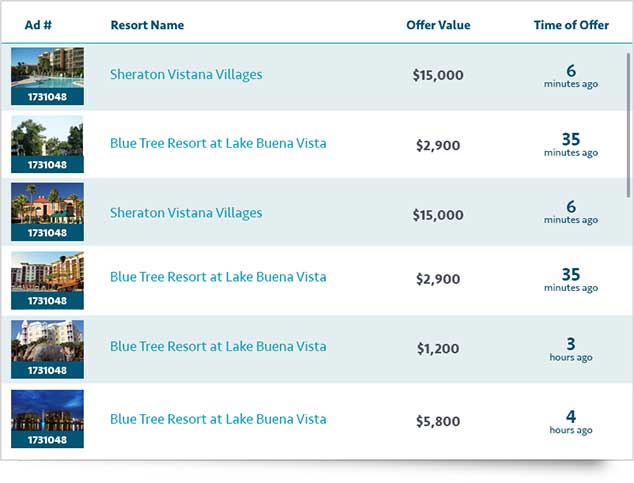
Interested in purchasing a timeshare resale property? Fill out the form to the right to speak with an experienced timeshare resale specialist. If you have a timeshare resale you would like to advertise on our high-traffic website, our sales experts will be happy to assist you.
Interested in learning about timeshare resales? The experts at SellMyTimeshareNOW have compiled a list of answers to the most frequently asked timeshare questions. Knowledge is your most powerful asset when negotiating to buy or rent a timeshare – read on to become well-versed in the intricacies of timesharing and the timeshare resale industry. And if you can't find what you're looking for here, please do not hesitate to contact one of our knowledgeable customer service representatives or simply fill out the form to the right.
For your convenience we have divided our Timeshare FAQ into two sections:
Simply click on any question below to view a complete answer. Click on the question again to hide the answer.
A timeshare is a form of vacation property ownership (most commonly of a resort suite) in which the owner possesses a legal agreement with a resort that entitles him or her to vacation there for a specific interval of time (commonly one week per year for a set number of years). Timesharing is a form of joint ownership (or leasing, in some cases) by multiple individuals.
Vacation ownership, vacation clubs and vacation memberships are other terms used to describe shared ownership of vacation real estate.
In most cases, timeshares are sold in intervals of one week (seven days). While week-based intervals are the most popular, other types of time shares do exist, such as points-based ownership and vacation club memberships.
Many resorts allow owners to rent additional time at a reduced rate unavailable to the public. Resorts often call this "bonus time".
Fixed intervals are identified by a number from one to fifty-two. For example, the first full week of January is Week 1, and the last week of December is Week 52. When you have a fixed week you can only stay at the resort during your assigned week (and typically in an assigned unit) that does not change from year to year. View our timeshare calendar to learn more about fixed weeks.
Floating intervals require you to contact the resort to designate your desired week each year during an assigned "season". Seasons are usually designated by colors and are based on demand for accommodations during a particular time frame. Since the terminology varies among different resort companies, be sure to do your research before purchasing a floating resale timeshare week. Also remember that what you'll be able to reserve is based on availability (some weeks are always excluded for upper level memberships, and if you wait too long to reserve the week or unit you desire might not be available).
Most resorts use three principal colors to determine the demand of their seasons. Affiliates of Resort Condominiums International ( RCI, the largest timeshare exchange company) commonly use Red, White and Blue designations. Red is peak or high season when there is greater demand for weeks; White is mid season when there is an average demand for weeks; and Blue is off-peak or low season because there is a marked drop in demand for weeks. Affiliates of Interval International (II, the second largest exchange company), on the other hand, use Red, Yellow and Green designations for high, average and low demand seasons, respectively.
A note to prospective timeshare buyers: Since demand affects price and trading power, seasons are an important factor to consider before investing in a vacation property.
Annual usage is the most common form of vacation ownership in which the owner is entitled to one vacation interval each year.
Biannual ownership entitles the owner to two vacation intervals per year.
Biennial ownership entitles the owner to one timeshare interval every other year.
Triennial ownership entitles the owner to one vacation interval every third year.
Timeshares are anything but typical accommodations, and there isn't a one-size-fits-all description of the "typical" suite. Timeshares can range from hotel rooms, to studio units with small kitchenettes, to spacious apartment-style suites with three bedrooms, to vacation townhouses with upwards of five bedrooms. The type and size of the time share resale property you select will depend on your needs, the size of your family and the destination you choose.
Traditionally, timeshares were suites or condominiums at luxury vacation resorts. However, due to the popularity of the joint ownership model, the concept has since been applied to everything from campgrounds to houseboats.
Unlike hotel rooms which just consist of a bedroom and a bathroom, the standard features in most timeshares also include a kitchen or kitchenette, a separate living and dining area, a private balcony or patio and stylish furnishings and decorations.
In many timeshares, you will also find additional luxurious features designed to make your stay unforgettable. These can include but are not limited to multiple bedrooms and bathrooms, Jacuzzis, washers and dryers, flat-screen televisions, stainless steel appliances and designer furnishings.
A note to prospective timeshare buyers: Standard and possible features described above reflect the typical amenities of a one-bedroom timeshare unit. Amenities will vary by resort as well as by unit. Before buying or renting any resale time share, be sure you know as much as possible about the unit and that the owner answers any specific questions you might have.
A lock-off unit is a timeshare which can be separated into two (or more) smaller, independently functioning units. For instance, a two-bedroom lock-off can be split into a one-bedroom unit and a studio unit. Lock-off units (also known as "lock-out" units) provide several options for usage. You can use both sides of the unit simultaneously to accommodate more guests; you can save use of one side of the unit for an additional vacation week that year; you can rent one or both sides to a non-owner; or you can exchange a week in one side of the unit for a vacation week in a similar unit at an entirely different resort.
Simply choose a pet friendly resort and your furry companions are more than welcome to share the joy of timesharing with you! For more information about pet friendly timeshares and for a list of the resorts we currently have available, please visit our pet friendly resorts page.
One of the most exciting things about timesharing is the opportunity to exchange your interval for weeks at other resorts. There are two types of exchange options available to owners - internal exchange and external exchange. Internal exchange refers to the practice of trading your week for an interval of similar value within the same resort family or group. For instance, an owner of a Wyndham Bonnet Creek timeshare in Lake Buena Vista, Florida, might trade her interval for a week at Wyndham Pagosa in Pagosa Springs, Colorado.
External exchange refers to the practice of "depositing" or "banking" your time share week with an exchange company so that you can then trade it for a week at a resort outside your resort family or group. For instance, that same owner might exchange her week at Wyndham Bonnet Creek for a week at Diamond Resorts Polo Towers Suites in Las Vegas using the services of an external exchange company.
The three largest and most well-respected exchange companies are Resort Condominiums International (RCI), Interval International (II) and Trading Places International (TPI). To learn more about how you can utilize these exchange companies after purchasing timeshare resales, please follow the links below or visit our timeshare exchange page:
RCI awards three distinctions to resorts in its network: Hospitality, Silver Crown and Gold Crown. The Hospitality award is given to resorts that consistently excel in hospitality and the check in/check out process. Silver Crown and Gold Crown awards are given to resorts that excel not only in hospitality but also in unit amenities, resort amenities, guest services, housekeeping and general maintenance. Distinctions are awarded based on RCI member ratings.
Interval International rates its in-network timeshares using a star-system. A Five-Star distinction is the most desirable rating. II's rating system is comparable to that of RCI.
A maintenance fee is a mandatory fee that the resort management company or homeowners association charges its owners for the upkeep of the timeshare unit and the resort property and grounds. This fee most often covers property taxes, utilities, insurance, and any other maintenance expenses including beautification of the unit and property. Maintenance fees are generally levied on annual basis, however, certain resorts may levy them monthly or biennially.
A time share resale is simply a time share which is being sold by the current owner rather than by the resort – often at a price well below the retail value.
Timeshare developers accumulate significant marketing related expenses - primarily through costly timeshare promotions which offer free giveaways in exchange for consumer attendance at high-pressure timeshare sales pitches. Even if you don't attend one of these timeshare promotions, when you purchase directly from a resort, you pay to absorb all of the administrative and marketing costs associated with the sale of the property. When buying from a current owner, you pay only the fair market value of the timeshare - a price that's often upwards of 50 percent less than the developer's price.
This might be the most important question about resale timeshares listed on this page! As such, we have created an entire page about time share resales - simply click the link for in-depth information on this topic.
Pricing of timeshare resales varies depending on a variety of factors. These factors include - but are not limited to - the time of year (season), location, resort amenities, size of the unit, unit amenities and, of course, market demand.
If you already own a timeshare and are curious about its current resale value, please take advantage of our free timeshare value survey.
Except in very rare cases, any and all rights of ownership (such as membership in the resort owners association) are transferred directly from the current owner to you when you purchase on the resale market. Restrictions apply for certain companies like Disney Vacation Club, which offers additional perks to members who purchase through the club rather than from an owner. Each timeshare buyer should consider his or her lifestyle to decided whether these additional perks are worth the (significant) added expense of purchasing through the resort, and then make an educated decision.
Points are a unit of measurement sometimes used to determine the value of a timeshare interval. Points are assigned based on a week's desirability in terms of season, size of suite, amenities and location. The more desirable or in-demand a resort week is, the more points it is worth.
If you are considering purchasing from an owner whose resale timeshare is part of a points-based system, don't fret that you will not enjoy the same benefits that traditional timeshares afford owners. Many respected multi-destination resort groups (like Disney, Wyndham and Bluegreen)-use points-based programs to provide their owners with flexible usage options that allow them to stay for a shorter or longer period than the traditional week-long timeshare interval.
Vacation clubs are a type of vacation ownership (often referred to as a membership) that commonly utilizes a points-program (see previous question). Vacation club members are given points each year which can be used at resorts within the club's network. As with traditional timeshares, vacation club memberships can be sold on the resale market, since a legal deeded or right-to-use contract (see below for a detailed explanation) can be transferred to a new owner.
Deeded timeshares are treated just like traditional deeded real estate. In other words, once you have purchased the timeshare, you own it in perpetuity. It is yours to use, give away, rent out, sell or leave to your heirs. When purchasing a deeded time share resale, be sure that the new deed in your name is recorded in the county where the vacation property is located.
Right-to-use timeshares (RTU) are commonly found in locations where deeded ownership of vacation properties is not permitted by law (primarily outside the United States). Instead of a deed, the owner is given a contract very similar to a lease which defines a set time during which the owner has claim to the property. RTU contracts commonly encompass time frames ranging from 20 to 99 years. If you are thinking of purchasing a RTU resale time share, be sure you know how many years of usage are left on the contract before initializing a sales transaction.
YES. In fact, SellMyTimeshareNOW recently partnered with Prosper.com to offer competitive resale financing to every timeshare buyer. With fixed rates as low as 7.4% and flexible repayment options, there isn't a better way to finance your dream vacation property. Click here if you are interested in timeshare financing from Prosper.
Resale timeshare closings can be legally complex, but complete timeshare closing and title transfer services are available from a variety of well-respected companies. Their services can be all-encompassing (including deed preparation, management of the escrow of funds, and preparation of timeshare estoppel certificates and closing statements), or they can handle any single aspect of the closing which you do not feel capable of handling yourself. We recommend that our timeshare buyers and sellers work with Chicago Title Timeshare. Buyers, please be aware that in almost all cases you are expected to pay the fees associated with the closing and transfer of the title.
Click here to learn more about timeshare closings.
Couldn't find what you were looking for on this page? Click below to view additional timeshare resale resources.
If you have any more questions about timeshare resales, please call the highly knowledgeable staff at SellMyTimeshareNOW at (877) 815-4227.